
Smart money management for Everyone
What I Learnt About Being Homeless: It Can Happen to Any of Us
We build our lives on a foundation we assume is solid: a job, a rental agreement, a predictable tomorrow. We look at the person sleeping on cardboard and create a mental checklist of their mistakes, a silent mantra that we are different. We are careful. We are safe.
I believed this too, until the foundation crumbled under me in a matter of weeks. The distance between a stable life and no life at all is not a vast chasm. It is a series of thin, fraying ropes, and when they snap, the fall is terrifyingly fast.
Homelessness is not an identity; it is a circumstance, a brutal lesson in the fragility of the modern safety net.
The Myth of the Single Catastrophe
We imagine homelessness begins with one dramatic, cinematic event, a house fire, a devastating diagnosis. The reality is a cascade of small, interconnected failures. It starts with a missed paycheck because the company is restructuring. Then the landlord’s grace period runs out. Your support network, the friends you could call, is already stretched thin helping others. The car, your last asset, needs a repair you can’t afford, making it harder to get to job interviews. There is no single point of failure, only a chain reaction where one broken link puts unbearable strain on the next. The system is not designed to catch you during this slow-motion fall; it is designed to penalize you for it.
Your Network is Your Net Worth
Financial advisors talk about net worth in terms of assets and liabilities. On the street, your net worth is the strength and generosity of your human connections. When your phone is cut off, your email becomes your lifeline. A library computer with a one-hour time limit is your office, your social hub, your connection to potential work. I learnt to be ruthlessly efficient with that hour: sending applications, responding to emails, scanning for resources.
A friend’s address to receive mail, a relative’s couch for two nights, a former colleague who could spare a meal, these were not small favors. They were critical infusions of capital into my survival economy. The most valuable thing you can own is not a thing at all; it is the goodwill of other people.
Invisibility is the First Symptom
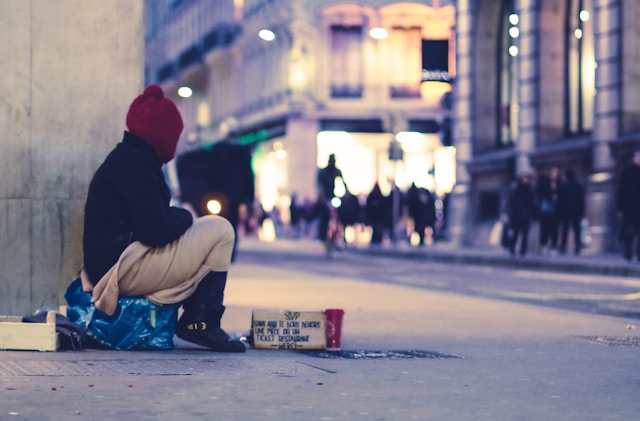
The moment you're homeless, you begin to fade from the world’s view. You are not a customer, not a tenant, not a neighbor. You become part of the urban scenery, something to be stepped around.
Shop security watches you more closely. People avoid making eye contact. The polite, professional language you used in your old life is now met with suspicion or indifference.
Your opinions cease to matter because your societal status has been revoked. This social invisibility is as dehumanizing as the physical discomfort. You are a ghost in the machine of a city that once felt like yours.
The Exhausting Math of Basic Needs
Stable life involves routines. Homelessness is a constant, draining calculation of logistics. Every basic need becomes a complex problem to solve.
Hygiene: Where can you use a restroom without being a paying customer? Where is there a public shower, and what do you do with your belongings while you use it?
Safety: Where can you sleep where you won’t be robbed, assaulted, or moved along by police? Is it better to be cold and hidden, or visible and vulnerable?
Possessions: Every item you own must be carried. A backpack becomes your entire world. A gift of a book is also a gift of weight. You learn to value multi-purpose items above all else.
The mental energy spent on this daily calculus is energy that is not spent on job searching, healing, or planning for a future. The system keeps you trapped in a relentless present, fighting for the next hour, not the next year.
The Bureaucracy of Despair
Seeking help is a full-time job with its own unique set of barriers. Assistance programs require documentation you may no longer have: a driver’s license, a bank statement, a utility bill. They operate during business hours, which are the same hours you need to be looking for work or waiting in line for a meal.
You spend days navigating around your options and waiting in crowded offices, only to be told you are missing one form, that you are in the wrong queue, that your case is not unique enough.
The process is designed to weed out the less determined, and exhaustion is its primary filter. The greatest barrier to getting back on your feet is often the very system meant to help you stand.
A Redefined Understanding of Wealth
You learn to measure wealth in units you once took for granted.
A full battery on your power bank is wealth.
A clean pair of socks is wealth.
A sunny, dry day is immense wealth.
A stranger who looks you in the eye and asks your name is a moment of profound human connection that feels like a fortune. The desire for luxury evaporates, replaced by a primal craving for dignity, for a locked door, for a quiet space that is yours alone.
The goal is not a new car or a vacation; the goal is a key.
The most important lesson is the destruction of the "us and them" narrative. The person you see on the street is not a different category of human. They are you, on a different timeline, with one or two more broken ropes.
This experience is a lesson about societal fragility. It taught me that compassion is the most practical currency and that community is our only true insurance policy. The next time you walk past someone, remember the cascade, the invisible calculations, the fragile network.
See the person, not the circumstance. It can happen to any of us, and that recognition is the first step toward building a world where it happens to far fewer.